Wednesday, November 16, 2011

Smoked salmon for breakfast...not in Cambodia

File this under first world problems, but I can't get a decent western breakfast in Cambodia. I rarely want one, anyway. I'm not a breakfast person and if I am going to eat breakfast, I'd rather have bai sach chrouk than toast and tea, anyway.

But once every few months I want a breakfast that includes smoked salmon. As I begin my rant, I'd like to say that smoked salmon is available here, at Lucky supermarket. It's $4 for a frozen package that's from Norway and quite good. It contains enough to cover a good six or eight bagels without skimping. Yet for some reason the expat/NGO dumpholes act like this stuff is as rare as a Cambodian orphan without any living parents.

 Over the weekend I went to Metro for brunch. Metro is a place that activates about a dozen pet peeves in me, being a hangout of overpaid expats and the Khmer riche, both of whom have the capacity to break me out in hives. But, they have a pretty good brunch.


I ordered the eggs benedict with smoked salmon and it was beautiful. I can't deny that. But when I took my first bite, I was overwhelmed with the taste of chemicals.

They had spread margarine all over the English muffins, I realized. And not a nice American margarine, this was straight out of some Chinese toothpaste factory. Further inspection revealed that the Hollandaise sauce itself was not made with actual butter, but this same low-quality margarine. To add insult to injury, the two quarter-sized pieces of lox were doused in the stuff, and the meal cost more than 8 times what a nice plate of bai sach chrouk would.


So that was Sunday. Then this morning I was at Java Cafe, another hot spot for NGO workers in biz casual talking loudly on their mobile phones and drinking lattes. I was just there to drop something off, but after having a long conversation with someone about how pointless it is to eat western food in Cambodia,  I gazed longingly at the bagels. Is it too much to hope for a big Jew-y bagel and lox? The answer, unfortunately is yes.

I ordered the bagel with capers and shallots. They brought me a bagel with one slice of salmon on one side of the bagel and no cream cheese. I went and asked for cream cheese, and after a while, was finally given a shmear. It was okay, but the salmon wasn't as nice as the frozen stuff at Lucky, and the niggardly portion wasn't enough to cover both halves of the bagel.

When I went to pay, I found out that I had been charged an extra $1 for said shmear of cream cheese. Same price as a plate of bai sach chrouk and a bowl of soup.

Here's the breakdown:
Bagel, lox and cream cheese - $2.75
Bagel, lox, capers and shallots - $3
cream cheese - $1

So the addition of capers and shallots to the bagel with lox and cream cheese costs $1.25, an increase of 45%. Keep in mind, shallots cost less than 1 cent each here, and capers are available in bulk quantities for less than in the US. And before you tell me how lucky I am to get a bagel for $4, restrain yourself until you've moved to Cambodia and dealt with all that entails.

Why does this bagel bother me so much? Is it just because I am broke and resentful? Perhaps. But the problem with Cambodia is that nothing makes sense. There is no obvious logic to the prices, there is no one to ask and there's no point in trying to find out more.

In trying to figure out why this bagel irritated me so much, I came to the conclusion that I was irked that they bothered to serve it at all. If you're going to make a bagel with lox, do it right. Don't leave out the cream cheese. Don't only put salmon on one side of the bagel. Go big or go home. I'll pay double for a totally delicious onion bagel with cream cheese, onion, capers and lox and I won't complain about the price. But I will complain about the price (and everything else) when I go home unfulfilled.

The moral of this story is if you're going to bother with western breakfasts, the DIY kind are always the best. Otherwise just enjoy that bai sach chrouk I can't stop banging on about.

Café Metro No. 271 St. 148, Phnom Penh
Java Cafe 56 Sihanouk Blvd, Phnom Penh

Tuesday, November 1, 2011

Char...it's what's for dinner

Meals are simple affairs in Cambodia...when it's not a wedding or funeral or engagement party or the King Father's birthday or an auspicious day to open a new office or Pchum Ben or one of the other seemingly bazillion Cambodian holidays.

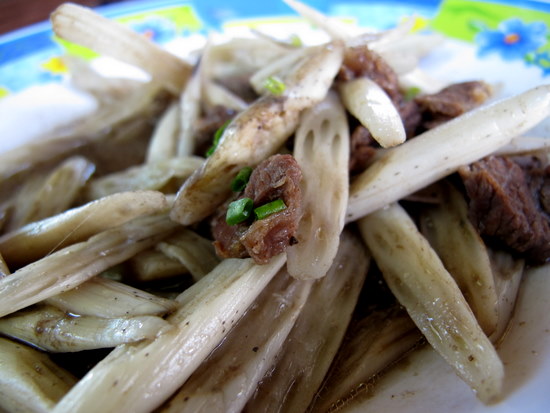
Beef and lotus rootlet char, from a roadside stall in Kandal province.

But on an average day, for an average Cambodian, char is what's on the menu. Char just means stir-fry in Khmer, and if you look in any of the handful of Cambodian cookbooks that are out there, you won't see very much of it. That's because char dishes are too simple, too, dare I say, boring, to make it into the cookbooks (haven't you heard that Cambodian is going to be the new Vietnamese?) So cookbooks focus on special occasion food, royal cuisine and the dishes that seem more exotic, and ignore what Srey Oun and her family are having for dinner.

Lunch in the provinces: bitter melon soup, char made from crabs picked out of the rice paddy, snails, tomato and pork char and lots of rice. 

Here's what's in most char dishes. One type of meat or fish, and one type of vegetable. The protein can consist of frog, chicken, crabs, fish, prawns, pork, squid, eel, liver, clams, snails or beef. The vegetable might be one of the following: cucumbers, winter melon, tomatoes, Kampot pepper, eggplant, lotus rootlet, baby corn, pumpkin, peppers, chives, mushrooms, papaya, water spinach, mango, ginger, green beans, pineapple, bok choy, bean sprouts, lemongrass, daikon, squash or chayote. Other vegetables and herbs are used in Cambodian cooking, of course, but these are the ones that are most often used in a char dish.

Barely ripe tomato and pork char with scallions.
Here's what most people add to a char dish. Oil, garlic, salt, sugar, soy sauce, fish sauce, black pepper and MSG. Sometimes oyster sauce and corn starch is added. The dish can be garnished with cilantro or scallions, and is always served with rice. The best way to torture a Cambodian from the provinces is to feed them a lunch that has no rice in it -- it does not matter if it is eight slices of sausage pizza, they will complain that they don't feel full and happy without at least a bowl or three of rice.

After taking the weekend off from office work, Rina goes home to work the rice paddy and make lunch.

Some chars will have two types of vegetables, but usually it's just one, and it's always one type of meat. Whereas westerners use vegetables to garnish huge steaks, Cambodians use small pieces of meat to add flavor to vegetables. Chars are usually mostly vegetables with some small bits of meat thrown in. When I was out in Kandal province with my friend Rina, we went shopping together (by shopping I mean picking over the fly-infested pork her neighbor had brought over from town a few hours earlier). For a group of 9 or 10 people, most of them adults and most of them having spent the morning doing grueling work in the rice paddies, Rina bought a piece of pork that was probably 4 ounces, half the size of an average steak in the States.

Lunch in the provinces: a char made from a vegetable called nor nung and beef.
At a family meal, usually one or two types of char are served and a soup. All of the dishes are served family-style, with each person having their own bowl of rice.The soup is spooned onto rice and eaten that way. No one seems to drink water during a meal except the barangs (perhaps explaining the regular mass faintings in Cambodia).

Cucumber, tomato and chicken char made by your truly, in an attempt to find an Asian husband.

Perhaps unsurprisingly, I've completely assimilated to Khmer culture, and make char for dinner all the time. It's simple and delicious, and worthy of being in the Cambodian cookbooks. You can find dozens of char recipes at this fantastic site, khmerkromrecipes.com.

This is not the sort of dish that really requires a recipe, but here's one I wrote down while watching Rina cook up a storm for her family.

Cambodian Char

3-4 cloves garlic, roughly chopped
vegetable oil
pork, chicken or beef cut into thinnish pieces
fish sauce, to taste
1 or 2 tsp sugar
1 small tsp MSG (optional, of course)
2 cups vegetable of choice, such as tomato, cucumber, melon, green papaya
black pepper
scallions, chopped

Heat up your wok and add oil. When it's hot, add the garlic. A minute later, add the pork. Cook for a minute or two, then add the fish sauce, sugar and MSG.

Add one cup of water and the vegetables.

Cook 2-3 minutes or until everything is done (but not overdone!)

Add black pepper and garnish with chopped scallions.

Serve with rice.

Tuesday, October 18, 2011

7 things you didn't know about Cambodian kitchens

Or maybe you already knew all of this. But I certainly didn't when I first moved to Cambodia.

 1. No ovens

 Ovens are not a traditional part of Cambodian cooking, which relies most on stir-frying, grilling and soups. The only way to get an oven in a Cambodian flat is to rent an apartment that's been tricked out for Westerners (and if you have an apartment with an oven, you're probably paying double what everyone else pays) or buy a standalone oven. I have done neither of these things, and have lived without baking for over a year now.

My current, tiny Cambodian kitchen. At least it has a cabinet.
 2. Bugs

 A standard part of tropical living, my kitchen is filled with creatures. This is not because I leave food sitting around, this is because the weather is conducive to critters, I live in a slum and my neighbors have different standards of hygiene than I'm used to (ie. they leave rotting garbage all over the street). At this moment, I have a dragonfly trapped in my kitchen who refuses to leave. Most days, there are at least a few geckos staring at me blindly as I prepare my lunch.

 The worst are the ants. If I cut an apple on the counter and don't wipe the counter down afterwards, within 6 to 8 minutes, the entire counter is swarming with ants trying to lick the knife. They expectantly wait on the edge of the sink for the water to dry, allowing them to traverse the edges of my drain for stray grains of rice. I have come to believe that the ants are not just innocently trying to feed themselves, but are only here to antagonize me. At one point in my life I didn't believe in pesticides. Now I use Raid like hairspray.

3. Gas burners

 Perhaps this goes without saying, but I was surprised when I moved here to find that my stovetop involves a giant gas tank and a couple of burners. Apparently not turning off the gas is incredibly dangerous, but I cannot remember to do this. One of my friends tells me this is because I was not raised watching Asian soap operas where someone would ring the doorbell and the entire house would explode because of some housewife's failure to close the gas tank. When I die in my apartment inferno, people will point to this blog post as an eeire forecast of things to come.

4. No storage

 Most Cambodians only buy as much food as they will serve to their family that day. They do not understand the concept of buying in bulk. Even staples like uncooked rice can be bought in portion-sized servings. The average Khmer will have bottles of oil, soy sauce and fish sauce, and containers of sugar, salt and MSG next to their gas burner. And that's it. Because they do not understand the Western desire to compulsively hoard food, they do not put cupboards or storage of any kind in the average Cambodian apartment. If you are lucky, you'll find a small tiled pantry, but many kitchens do not even have this. My kitchen has a giant bookshelf that I moved into it, which is a constant reminder of what a glutton I am.

My first kitchen in Phnom Penh. Who needs food storage when they shop every day?
5. MSG

 Yes, I said it. All Cambodian kitchens have MSG in them, usually in at least a few formats. The salt-like crystals, the chicken powder, the chili sauce. The great majority of Khmer household chefs seem to be...not lazy, exactly, but interested in making cooking as quick and dirty as possible. That said, their dinners are pretty good so maybe they are on to something.

6. Hot

 Another probably obvious one, but Cambodian kitchens are hot. The temperature here hovers around 90 most days, but the 70% humidity brings the "feels like" temperature over 100. Even at night. About 20 degrees more, and that's my poorly ventilated kitchen. Imagine trying to prepare dinner in a dry sauna and you'll know what my mealtime is like. This is why many families drag their little grill onto the sidewalk outside their house and make dinner out there.

7. Fruit and veg 

Lest I seem like I'm complaining (I'm not), there's another addition to my kitchen that was non-existent when I lived in London and Dublin. Fresh fruit and vegetables, and not of the depressing potatoes and cabbage variety. I can get fresh mangoes for $0.25 apiece here, and right now I've got fresh papaya, bananas and lychees waiting for me to devour them. I used to pay 60 cents for one stalk of lemongrass when I lived in London -- now I pay 2 cents per stalk. There are a plethora of vegetables on offer here, and though I don't know what half of them are, I appreciate their existence. For the first time in my life, I am getting my 5 a day and I'm not even trying.

Monday, October 17, 2011

Some Cambodian food stories

I've had a couple of food articles out lately -- if you're looking for more info on the Cambodian food scene, please check 'em out.

Outtake from the delicious Cambodian dishes -- taken at 54 Langeach Sros on St 178, Phnom Penh.

10 Delicious Cambodian Dishes at CNN Go

Destination Cambodia: It'll all end in beers. An article about Phnom Penh beer gardens -- where to drink and what to eat. From the South China Morning Post.

My street food series on Travelfish:

Phnom Penh street food: Bai sach chrouk
Phnom Penh street food: Coconut milk desserts
Phnom Penh street food: Nom banh chok
Eating crickets in Phnom Penh

I've got a lot more food stories and restaurant reviews on the Travelfish Phnom Penh blog, if you're interested.

Tuesday, August 23, 2011

Finally getting on the bento train


I've been interested in bento since I was a teenager and discovered the Sanrio store at the Fairfield Mall. I can't say that I actually made lunch with any of my Kerokerokeroppi accessories more than a few times -- my bento box seemed far better suited to carrying my collection of mentholated cigarettes and hairclips.

When I traveled through Japan on my grand tour, I wistfully looked at all of the bento boxes, desperately wanting a Mameshiba one but not being able to justifying buying something that I'd have to carry around for the next twelve months on my back. So after settling in Cambodia last year, I vowed that eventually I'd get into bento.

Here's what I made:

Chicken kaarage, Japanese fried chicken
My dad's perfect sesame noodles (if anyone is interested I'll post the recipe)
Sunomono salad, Japanese cucumber and wakame salad
Sliced watermelon
Longans
Cherry tomato

It was a pretty successful first attempt. I think I got the balance right of carbs/protein/fruit/vegetables although I could have probably got some extra veg in there. I've never actually made fried chicken before so the experience was sort of terrifying and at the same time, pretty cool. Lots of oil going everywhere and me squealing and shrieking.

It was especially gratifying because I just left the whole mess in the kitchen for the cleaner to deal with -- which almost made up for the dengue fever when it comes to this living-in-Cambodia lark.


My tiny ridiculous kitchen.

Monday, August 15, 2011

On hunger and tropical fevers

I've recently recovered from a whopper of an illness that included a staph infection caused by itching a mosquito bite, and a tropical fever, thought to be dengue, that quite probably sprang from the same mosquito bite. This my friends, is tropical living at its best.

I spent about three weeks in bed, crying mostly, and watching DVDs (thank goodness for lax copyright protection in Cambodia, where DVDs cost $1.50 each). The strangest thing about the whole illness, other than seriously wondering if I really was going to die in some Phnom Penh alley that reeks of rotting garbage, was that I lost my appetite.

I mean really lost it. I just wasn't hungry. I'd think that maybe I should eat something, but couldn't think of anything that seemed tempting. A friend brought over Indian food and I couldn't force myself to eat it. I felt like I'd already eating three lunches and was trying to eat another -- I wasn't in the slightest bit hungry. I went for entire 24 hour periods without thinking about solid food.

This was a strange experience for me. Bizarre, even. I am always hungry. Even if I am not hungry, I am capable of eating a full meal at any given time, even if I've just finished one. When I've been sick in the past, I've never been able to figure out whether you are supposed to feed or starve a cold or flu, so I'd feed both. Terrible bouts of food poisoning wouldn't put me off eating -- I'd just have lunch and wait for it to come back out again. I've never lost my appetite before.

It took dengue fever to give me an insight into what normal people live like. I've always wondered what it must be like to be stupid, and finally got the opportunity to find out after having my wisdom teeth removed and being rendered mute and moronic by the dental drugs for over four hours. By the time I "got" a joke, it would be minutes later, far too late to respond. I finally understood what my high school classmates had to endure, having hit every branch on the way down from the stupid tree. I felt guilty for every "duh" I spit out at them over the years.

And now, being indifferent to food. I finally understood the girls who said "Oh I don't care," when you ask what they wanted for lunch. "It doesn't matter. Whatever." "Oh, I'm not hungry." Uh, yeah.

If you ask me what I want for lunch, I always care. It always matter. But not with this tropical fever, it took my very humanity away. I had become one of them -- those people that don't care about food.

Nothing sounded tempting, and after a few days of consuming nothing but water, I knew I had to force myself to eat. The only things that sort of sounded halfway edible were sweets. But the sweets selection here is lacking, and I was unable to leave my house. Finally, I managed to source a few -- and I'm ashamed to admit this -- Better Crocker cake mixes. I've got no oven of course, because I live in Cambodia, so once a week I'd pull myself to a standing position and dump the whole lot into my Crock Pot, wait four hours and force some slow-cooked instant cake into my mouth. The old Lina would have been able to eat an entire cake in one sitting, relished it, in fact. New, normal Lina found even a small piece of much-anticipated cake overwhelming.

I'm back to my old self now. Indeed, I just had to eat a curry to get through writing this post, but I'm glad that I had the opportunity to be exactly the person I've never been before and with any luck, will never be again.


Monday, July 11, 2011

The mile-high supper club

There are a few things in the world that I'm obsessed with: Italian disco, flat-footed squatting, street food, and collecting miles. There's no way around it, I'm a miles junkie. This is an addiction that has paid off, and with a little help from the FlyerTalk lending team on Kiva, I did my most recent trip "up front."

Of course what I find most exciting about business class is the food. I can't tell you why, because even the best business class food is still marginally worse than what you'd get at the airport, but there's something thrilling about being called Miss Goldberg and having a table set for you, especially when you're essentially in bed and watching Inception at the same time. I've always loved airplane food, though, ever since my first cross-country American Airlines flight alone at the age of four. There's just something thrilling about all of the little meal components and the toothpick and asking for another soda (or wine, these days) and getting it. I can't explain it, but I love it.

I didn't manage to take pictures of all of the meals I ate on this trip (and it was quite a trip, from Phnom Penh to Bangkok to Barcelona via Amman and Madrid, to New York (with a detour in the Berkshires) and back to Phnom Penh via Vancouver and Hong Kong, a lot of flights). But here are a few highlights. Unfortunately most were taken with my phone because I was trying to play it cool.


Royal Jordanian airline had the (to my palate) strangest meals. Perhaps this is because I know nothing about Jordanian cuisine -- before this flight I hadn't even realized that Jordan was a country and not just a New Kid on the Block. Unfortunately I didn't keep the menu for this one, but it was certainly bizarre. Lots of processed meats and a tomato stuffed with some sort of mayonnaise-based salad.


This is the standard Iberia meal for short-haul flights right now. It's cold, and sort of disgusting but also a little bit appealing. Pasta with some slivers of cold fish and caviar, and mysteriously, a soft, Brie-esque cheese. Served with a small bottle of olive oil. Torres wine which ain't bad.


Long-haul Iberia from Madrid to New York was much more rewarding. This was the starter plate: hot bread with extra-virgin olive oil, salmorejo with egg and iberico ham, small potatoes salad with tuna belly and smoked anchovy and a Pedro Ximenez balsamic vinaigrette. This was easily better than most of the food you'd find on the Ramblas in Barcelona, and I was happy to get one last anchovy into me.


Dessert on Iberia was a coconut and passion fruit cake by Paco Torreblanca.


Cathay Pacific had the best food, even if my pictures don't reflect it. My 20 hour flight from JFK-YVR-HKG sucked the life out of me so quickly that I forgot to take pictures (and it was just too dark onboard most of the time). My main was stir-fried prawns with X.O. sauce (love that stuff) and then I ended up with this tiramisu.


The worst picture, but my favorite airplane meal of the trip. This was breakfast of shredded pork and mushroom congee with pan-fried turnip cake with preserved meats on Cathay Pacific. I could eat this for breakfast every day. I love turnip cake.


And my final meal on Dragonair -- braised rice vermicelli with roast duck and snow vegetables and assorted dim sum.

Sunday, May 22, 2011

Intestinal fortitude: The good, the bad and the home-made yogurt

I’ve been a negligent blogger as of late. I’ve got this whole other blog that I actually get paid to write, and that’s been sucking a lot of my creative attention. That and I’m lazy.


But let’s talk about yogurt. One of the things that living in the tropics has done is to make me increasingly aware of the fragility of my own health. Cambodian doctors are more likely to kill you than make you well, many of the medications I’m familiar with aren’t easily available and medical care from a Western-trained doctor is ridiculously expensive. So I’ve started taking vitamins, exercising and eating yogurt in the hopes I won’t need to be airlifted to Bangkok someday.

Why yogurt? It’s great for intestinal health and the flora. Eating it supposedly makes you less susceptible to bad bacteria -- the kind you get from eating gnarly street food. Of course what it doesn’t protect you from is bad yogurt, which I deliberately chose to eat on Monday.

My only explanation is now that I live in a cowboy society without rules, I figured that the laws of science don’t apply to me either. I ate a big helping of yogurt that had gone bad, mixed with a curry to mask the taste, reasoning that since yogurt is basically spoiled anyway, eating a rancid bowl wouldn’t make any difference. I was wrong.

I’m someone that doesn’t have a lot of food hangups. I don’t check to see if vegetables have been washed safely, if ice is from a machine or if the street food vendor has clean fingernails. I just eat whatever looks good and figure that any intestinal distress that comes my way is just the price I pay for deliciousness. I believe that sustained low-level exposure to bacteria has also helped me build up an internal resistance that prevents me from getting sick very often. No so this yogurt.

Suffice to say it was gruesome and the fact that I was quite aware that I had deliberately eaten bad yogurt did not make the next 24 hours of spewing any more bearable. Quite the opposite, in fact. It was as bad as Bolivia, and that’s saying something. It's right up there with Rome and Peru in terms of being one of the great bouts of food poisoning in my life. My first in Asia, in fact.

By Wednesday I was walking again, and the thought of ever eating yogurt again made my legs go wobbly. But screw it, right? There’s nothing that will help one recover from a bout of extreme food poisoning like getting some good healthy bacteria into the old gut. The reason I got sick in the first place was because I ate day-old raita from an Indian takeaway. If it’s reasonably fresh, yogurt should not go bad after a day. But yogurt in Cambodia is never particularly fresh, dated properly, or reasonably priced. So I decided to make it myself.


Apparently making yogurt is actually really easy, which is bizarre because it seems like difficult prairie-woman work, like milking cows and churning butter. And Cambodia is a great place to make one's own yogurt as the daily 95 degree weather is conducive to all sorts of bacterial growth, yogurt included. As part of my now-I-live-in-Cambodia campaign, I bought myself a slow-cooker which has been gathering dust after a chicken feet-stock experiment a few months ago. So I found this recipe on Nourishing Days, bought some starter yogurt from the Bangladeshi market, and made myself a batch.

In Cambodia it is difficult to find plain yogurt. Most yogurt is imported from Thailand and is heavily sweetened. Even the yogurt marked “plain” is sweetened or vanilla-flavored. There’s one dairy that makes actual plain yogurt, but it’s expensive, the containers leak and it always goes off before the sell-by date. I tend to not trust the Bangladeshi because there are not dates involved whatsoever, so I never know if I’ve gotten today’s or last week’s batch.


But my yogurt -- oh it is so fresh and perfect! Despite the fact that I am still sick from the evil yogurt, nothing tastes better than my yogurt. I have been eating it in the mornings with fresh passionfruit and honey and thinking how lucky I am that I have access to passionfruit for next to nothing and enough time on my hands that can do things like make yogurt and worry about intestinal flora. This is the life.

Friday, February 11, 2011

Ten ways I managed to ingest sugar as a child, over parental objections

1. Breakfast Cereal

When I was a girl, when we went to the supermarket my mother would come up with an arbitrary number, I think it was around five or six, and say that we could only have cereal that had a lower sugar count per serving than this number. Upon reflection, I suppose it wasn't arbitrary, because it managed to eliminate anything tasty from our breakfast options, including that fence-sitter Honey Nut Cheerios. We were left with a sad array of possibilities: plain Cheerios, plain Rice Krispies, Corn Flakes, and Fiber One. This stopped me from getting the much need morning buzz and was probably the reason I turned to coffee at the tender age of fourteen.

The world seems a lot bleaker at seven in the morning without sugar or caffeine, and this was the state of my life when a babysitter suggested to me, around the age of eight, that I could just dump sugar on my cereal and it would taste better. Oh, Mother, if you only knew how those babysitters corrupted us! Anyway, after that, I would spoon at least three or four tablespoons of sugar onto every bowl of cereal that I ate whenever no one was looking, and by the time my parents actually caved in and started buying decent cereal and snacks I had grown indifferent, realizing that I was master of my own destiny.

2. Cinnamon Toast

Another creative way to eat sugar. Make toast, blob some butter on it, and sprinkle liberally with sugar and cinnamon. Resent children whose mothers bought them Cinnamon Toast Crunch cereal.

3. Chocolate Chips

Despite being raised in the house of the child of a health food nut, I am also my father's daughter. Luckily for me and my brother, my father was unwilling to cave to many of my mother's culinary demands. It is because of him that we often had chocolate chips in the house for various baking projects. (I know that my mother is going to jump in here and insist that she was the one who made the chocolate chip cookies, and yes, Mom, I love you for it.) We would raid the chocolate chips in handfuls on a daily basis until they were gone. This was the easiest sugar injection in our lives, and one we had to keep secret from the parents. They at least, to their credit, pretended to not notice our sticky hands and chocolatey faces as we bounced off the walls.

4. Baking Chocolate

Baking chocolate was sort of the child's equivalent of "ghost-busting," where crackheads pick up any bit of dust or gib of dirt off the ground and smoke it "just in case." As I remember it, baking chocolate was unsweetened, but still smelled enough like chocolate that I would attempt it occasionally.

5. Ovaltine

According to the family legends, Ovaltine was the one sweet food my mother was allowed as a child, because my grandmother -- or Ole Wheat Germ, as we call her -- had been convinced of the health benefits of all of those vitamins. As such, we were also allowed Ovaltine as children. Malted Ovaltine actually tastes healthy and is not good. Chocolate Ovaltine, though, tastes like real chocolate milk to a child who has been sugar-deprived. If you added twice as much Ovaltine as recommended, it only gets chocolatey-er.

6. Anna and Jeannette's House

Anna and Jeannette were the twins that lived up the road. They had an elderly aunt to watch them every afternoon who was notorious lax with the cupboard monitoring. Additionally, their mother apparently did not have great refusal skills, as she purchased any snack food that her five daughters may have possibly wanted (and she had five daughters, so resistance was futile). When I went to Anna and Jeanette's, I could have as many fruit roll-ups as I could eat, Oreos, gummy candy, ice cream and any number of treats that would inevitably spoil my dinner.

7. Egg Nog

Another mom-allowed after-school snack born of desperation. Consists of milk, egg, sugar, vanilla, nutmeg, thrown in the blender and add some food coloring to make it seem processed. My mother now denies that she ever made this for me. Then she says that raw eggs weren't considered a health risk back then and kids need a lot of protein so even if she did make it there's nothing wrong with that.

Further investigation has concluded that my mother was once fed this as a child on a doctor's advice (she had her jaw wired shut at the time) and as such, was convinced it was good for us.

8. Sugar Cubes

Yes, I'll admit it. I ate sugar cubes. After about three, it would set my teeth on edge and my cavities would start crying for mercy.

9. Old German Christmas Cookies

My father, ever the optimist, would often make Christmas cookies for at least a hundred people, despite the fact that we only knew thirty. This would often leave us with a store of hard, German cookies for months after Christmas. They were generally hidden behind the vinegar, because he didn't want my mother pointing out that he had made too many, just like she had told him he was going to. Luckily for him, I would raid these every so often. They were hard as rocks; you'd have to suck on them for a while before even a little bit would begin to crumble. These cookies were a great way to kill time and get a sugar fix.

10. Baking

In the end, I had to learn how to bake. God was not going to bring the cake to me, so I had to learn to make the cake. I think I started baking at around age ten or eleven, in the desperate grip of post-school sugar withdrawal. I started with the Joy of Cooking One Egg Cake which has only eight ingredients and can be made in under forty minutes. I've never looked back.

Monday, December 27, 2010

Back to Penang: Hoikken mee twice for lunch


I was about to write a potentially very boring post about how much I love Hokkien mee in Penang, and then I realized that I already wrote that post last March. I'm here for the holidays and harboring fantasies about moving here and spending the rest of my life doing nothing but eating hawker food. George Town is one of the best food cities I've ever been to. Last time I visited I didn't quite appreciate how easily I can communicate here, but after five months in Cambodia I've come to be very grateful when I meet bilingual locals that I can have actual conversations with. The vibrant (and vaguely hygienic) street food scene is made even better by the fact that every street food stand has a sign stating exactly what they sell.

My local food ambassador, Mr. Oon, loves Hokkien mee. Just out of the hospital he tells me that he nearly died, possibly from not having Hoikkien mee for a month. He said his doctor has just given him a clean bill of health and that he's now allowed to eat as much Hokkien mee as he wants (but he still shouldn't drink the soup, too much cholesterol). Of course he can't help but have a few spoonfuls every time. Too delicious, lah.

Today for our four hour lunch we started with the soupy Hokkien mee (above) and finished with Hokkien char mee from a different place with the same plates (below).


I've nothing to say about Hokkien mee that hasn't been said before, but I love that Mr. Oon loves it and made me eat it twice for lunch today. He's also twisted my arm into going for an even better version tomorrow morning.

My favorite part about Penang is that hawker-stalking is a full time job. I don't need to bother sightseeing--I spent all day trolling the streets George Town looking for hawkers on my list of recommendations, buttonholing locals trying to suss out the best curry mee, and walking past the koay teow th'ing place again, hoping they will finally be open. Who needs beaches when you can do this?


Tuesday, December 14, 2010

At the Seoul Airport


Korea's campaign to promote Korean food is bigger and better than ever this year. They have a website, a blog, ads in Times Square and the sort of airport decorations that my ideal model home would have. When I stepped off what I can only describe as a hellish flight from Phnom Penh to Seoul recently I was delighted to get onto a moving walkway that sped me past a quick forecast of what my next four days would be filled with.


Luckily I was true to myself and did exactly nothing (save for the odd trip to Korean teenage nightclubs) other than eat my way through Seoul. I got started immediately without even leaving the airport with a giant bowl of kimchi rice porridge.


I was pleased to see a number of dainty Korean airline employees finishing off these giant portions (I'd estimate each bowl to have at least six cups of rice in it) at 6am. Watching other people gorge themselves--especially those who are genetically slender--is always something that cheers me up. Luckily there's no shortage of that sort of thing in Cambodia, but there's definitely a shortage of Korean breakfasts. More on this later.


Tuesday, November 30, 2010

The Golden Triangle


The Phnom Penh expat scene is both lively and irritating. Luckily, there are a variety of overpriced watering holes for western ex-pats, well-connected Khmers and wealthy Korean students to find some common ground and buy expensive drinks. They've even got frozen blue margaritas, if that's your cup of tea.

Pictured above: A 'Golden Triangle' containing Tequila Sauza, Grand Marnier, lime, mint and a Tiger Beer floater, $3.90. (I did not order this.)

Café Metro No. 271 St. 148, Phnom Penh

Monday, November 29, 2010

What to cook for a monk and your dead ancestors?


Last month I woke up bright and early one Saturday morning to head to a pagoda with my colleagues for Pchum Ben, a Cambodian religious festival that is all about monks and dead relatives, two things that Cambodians take very seriously.

One of the cute things about my colleagues is that they seem to forget that I am not Cambodian as well, and as such, don't tell me crucial bits of information about events like these. I know about their propensity to leave out important details, so had done a bit of research before the big day (ie. I read the Wikipedia page about Pchum Ben) so I knew that I had to bring some food with me. (What I didn't find out was that I was supposed to wear a fancy skirt and a white top, but there are only so many battles you win at this sort of thing.)


Although I love to cook, I do not enjoy the pressure of cooking for a critical audience. Most of my colleagues have never tried foreign food and are uninterested in not-Khmer foods. Even more nearby-but-foreign cuisines like Indian or Malaysian food are unheard of in a typical Khmer household. And the way food is eaten--everyone gets their own bowl of rice and shares the other dishes--isn't conducive to western-style pastas or salads. So when I've cooked for my co-workers in the past, I've played it safe and made Thai dishes, which have gone over very well.

Because of the Cambodian habit of saying whatever comes to mind, I know that I will be sure to hear exactly what they think, "You're fat, this tastes bad." But for the holiday I decided that I finally make something extremely foreign. My plan had originally been to make Shrimp Saganaki, a recipe I made when I was in London and have been craving since, and it seemed like it could go with rice. But after wandering around a filthy market unsuccessfully looking for decent shrimp I revised my plan.


Everyone brought at least two bowls of food--one (or more, depending on how wealthy or religious one is) for the monks to eat and one for us to share as a group after the prayers. One of the managers brought a bucket (seriously, she had lined it with plastic) of a very fancy red curry made with coconut milk, chicken, chicken feet and blood. It was clearly special occasion food--around the office we almost never have coconut milk in anything. She put out a half dozen bowls for the monks and bowls and bowls of bread to sop it up with.

Every monk at the pagoda takes at least one bite from every bowl that is presented to them. My colleagues explained that the food the monks eat is transferred directly to our ancestors, so in essence, we're feeding our dead relatives.


Knowing this, I decided to make something my Irish-Italian grandfather would have loved. Can you guess which dish is mine?

I have to admit that I took great pleasure in the monks' quizzical looks as they inspected my pasta with porky tomato sauce, heavy on the tomato paste just the way my grandfather, Red, would have liked it. "You're going to make me eat this?" they must have thought.

The pagoda we went to was deep in Kandal province, near no tourist attractions and clearly unused to having foreign visitors. Despite my inappropriate dress and non-Buddhistness I was shepherded through the place and the prayers, had incense thrown into my hands and got to watch with delight as the monks chanted over my penne. I'm not one for religion, but that this was the sort of event I could get behind. What better way to remember the dead than to make their favorite foods?


So I know that your first question will be, did they like it? And the answer is not really. All of my colleagues tried a few bites and thought it was hilarious and very interesting, but no one loved it as much as I did (or Red would have).

The exception was one of my co-workers who made my day by eating as much as the twenty others combined. So I said a prayer for his dead ancestors too, because they obviously did something right.

Thursday, November 25, 2010

Thanksgiving in Cambodia


Thanksgiving dinner at Lone Star Saloon, Phnom Penh Cambodia. My first Thanksgiving dinner in a few years, and as expected, I feel disgusted with myself but at the same time incredibly self-satisfied. 

Sunday, October 17, 2010

When you buy vegetables at the supermarket in Cambodia...*


Resembling Watercress
"You look so familiar! You remind me exactly of this watercress I used to know."

*Do not construe this post as a suggestion to buy supermarket vegetables in Cambodia

Thursday, September 23, 2010

Another breakfast in Cambodia


For my first two weeks in Cambodia I ate rice every day for breakfast. I didn't have eyes for noodle soup, I was too busy feasting on random meats and rice and pickled cucumbers. There's no other way to slice it, this is a wonderful way to wake up. Especially for just $1.

Since that time I have tried to restrain myself, as I figure I have two other meals a day to eat rice. I don't understand how people here metabolize 5-10 cups of rice a day, but I commend them for it.

Meal above from the infamous noodle shop on the corner of Street 5 and Street 136, Phnom Penh.

Sunday, September 19, 2010

Breakfast in Cambodia: Khmer noodles


One of my favorite traditional breakfasts in Cambodia is nom banh chok, or Khmer noodles. A heaping bowl of noodles, gravy and vegetables served with a few chilis on the side. Like most food in Cambodia, it's served at room temperature, and often in a plastic bag.

There are usually two kinds of gravy, one that is made with fish sauce, lemongrass, garlic, salt, sugar and fish of some sort. My cultural ambassador (read: my co-worker) started to get flustered when I was grilling her around this so what I am telling you may be completely incorrect. The other gravy choice is called green curry, so I'm going to assume it's probably a green curry.

The noodles are made from rice--Eating Asia has a really interesting post on how they make the noodles for nom banh chok. Cambodians are serious about their nom bahn chok noodles. I have been told several times that Khmers invented these noodles and that many other countries have stolen the idea. I've met a few noodle makers and it's not particularly lucrative and very physically demanding. I don't envy them the job, but I'm eternally grateful that they do it.

The dish is served with shredded cucumber, banana flowers, water lily stem, long beans, lime wedges and a pile of vegetable leaves that I cannot identify.

Living in Asia has given me a new freedom with breakfast. Cereal, phhhht. I'd rather eat nom banh chok.

Friday, September 17, 2010

Eating North Korean in Cambodia


Anyone who has had to stomach my presence for more than a few hours doubtlessly knows about my interest in the politics of the Korean peninsula and North Korean specifically. I've ruled out going to the mass games (check the video) for political reasons but have been happy to discover that I can explore North Korea in Phnom Penh.

Due to Cambodia's habit of embracing the most corrupt world leaders, they have a long and close relationship with North Korea. We've got an embassy here,there are diplomatic missions, they sell North Korean kimchi at the grocery store and perhaps most importantly, I've got a window into North Korean cuisine.

I had long speculated that North Korean food was the more pure version of Korean food--what Korean cuisine was before it was tainted by imperialism, capitalism and mayonnaise.


The menu at Pyongyang Restaurant

I had the opportunity to find out when I visited Pyongyang Restaurant in Phnom Penh recently. The restaurant is allegedly run by the North Korean government as a place to launder money and funnel cash to the DPRK. The waitresses are all North Korean citizens as well. They're good-looking, play traditional Korean instruments and are dedicated to the cause.


Unfortunately there are no photos allowed in the place, so I didn't get any pictures of the food or floor show, but here's what I learned. North Korean food is not as spicy as south Korean food and there's much more focus on noodle dishes. There were a few banchan, but far less than any self-respecting South Korean joint would serve. The dishes were not nearly as complex or interesting as the Korean food I am used to. I'd use the word "rustic" to describe it. Everything was cut roughly and the bulgogi which is usually cut very thin was thick and tough. It was sort of like what your (Korean) grandma would make once she stopped giving a damn.

However, the floor show of six North Korean women singing, dancing and playing traditional instruments as well as the excellent decor highlighted by the bright fluorescent lighting made the experience of contributing ten bucks to the axis of evil well worth it.

Pyongyang Restaurant
400 Monivong Blvd(between Mao Tse Tung and Street 392)
Phnom Penh, Cambodia

Thursday, September 16, 2010

How we celebrate a new office


The organization I am working for recently opened a new service office in Kandal province. To inaugurate the place some of the staff and most of the management headed over in the large trucks and SUVs that are strangely popular among the Khmer riche.


When we arrived they busted out coolers and bags from the truck and started putting it all out on plates and setting up the Buddhist altar that is found in just about every office, restaurant and home in Cambodia. Everyone was very busy but someone managed to throw some incense into my hands and push me towards the altar to pray awkwardly. This may have been in large part due to my rumbling stomach--the five feet in from the altar was covered in various foodstuffs that I was having a hard time ignoring.


I definitely suffered for a while thinking all of this food was getting wasted on the gods and spirits of the place (and I was told that the extra table set up outside was for the angel) . But it turns out that Buddhism is a very sensible religion in that once all the praying and incense burning was done, we got to bring it all back to the office to share with the staff for lunch.


Our celebratory lunch. I sat next to the COO who kept adding spoonfuls of crab and other goodies to my plate. The crab had a variety of "sauces" to go with it. The ubiquitous fish sauce with chilis and another nice one of green beans cut very small, fish sauce and very hot chilis.

Twice the chicken we get in the west.

>
Cakes with coconut milk and a little bit of incense ash.


One of my best meals so far in Cambodia, both for the camaraderie and the food. Thanks, angels!