I don't remember the exact price of these dumplings, but it was pretty close to free.
I took a dumpling making class in Xi'an and although mine were obviously superior to everyone else there, they definitely did not look like these bad boys. Sigh.
Lijiang's old town is adorable--canals run along the side of tiny alleys, red lanterns hang from all of the ancient buildings and Naxi women chill out in the town square. The adorableness is not lost on the Chinese; Lijiang is a major China tourist attraction. After my disheartening foodie experience (cheap ingredients, high prices) in Pingyao, another town popular with Chinese tourists, I was apprehensive about my first meal in Lijiang.
To be fair, though, I'm apprehensive about most meals in China these days, as I've found that not reading or speaking Chinese can be a major roadblock to getting what I want and at a fair price. Find someone who doesn't know the rules to charades and try acting out the word "broccoli" to get a sense of what I'm talking about.
I was delighted when we wandered into a row of restaurants on the outskirts of the old town that were filled with teenage girls milling about in their blue and white or red and blue tracksuit school uniforms. (They had mostly disappeared by the time I took the picture above.) It was far enough outside of the main town that the tourists were gone, a girl was washing her hair with a coffee cup over the canal, and overall, the scene seemed promising for lunch.
Of course there was no English menu, so we went inside and just pointed at random ingredients that we liked. I have found out the hard way that if you point at a piece of beef you will end up with a plate of beef and nothing else, sometimes even no seasoning. Even worse, sometimes if you point at five ingredients they will think you want five dishes, each one made from just one of the ingredients. So I pointed at the pork and then waved my arms frantically over the entire vegetable section in a way that I hoped conveyed that I wanted a delicious assortment of veggies.
The Yunnan province, of which Lijiang is a part of, is known for a noodle dish (过桥米线) sometimes called across-the-bridge, crossing-the-bridge, cross-bridge or over-the-bridge noodles. You get the idea, it's about getting from one side of a bridge to the other. The story behind it is that a man would go somewhere far from home to study for his exams. Every day his wife would cross a bridge to bring him rice for lunch and every day it would get cold before she got there.
The ingenious woman decided to start bringing a bowl of hot soup with a layer of fat on top of it instead. Once she arrived, she would add fresh ingredients like vegetables and rice noodles to the soup, which was still hot due to the layer of fat on top. The vegetables and noodles would cook in the soup and the scholar would never have to settle for a lukewarm lunch again. Of course he passed his exams and became a rich man, and commemorated his wife's exertions by naming the dish she made after the journey she made over the bridge to deliver them to him every day. She was probably livid that he named them after the bridge and not her--at least I would be.
I had no idea that this meal was a specialty of the region, or even that we had wandered into a place that served it. I just pointed at a few ingredients and hoped for the best. Because of the touristy nature of Lijiang I had expected to get an overpriced, underwhelming meal. So imagine my delighted surprise when we were served two giant bowls of bridge noodles, brimming with fresh vegetables, a plate of ham and green onions and a giant bottle of Dali beer (they didn't have water, so what can you do?) for ¥37, about $5.40. And in keeping with Lijiang's reputation of perpetual springtime and nice weather, the sun was shining and I even managed to get a bit of color over lunch.
I know that I have already covered the Lay's Natural & Cool and Natural & Warm line of potato chips in exhausting detail, but while researching the subject I found a few more flavors that I wanted to share. Long story short, Chinese people like different flavors than Westerners. Some flavor examples on sale in Chengdu the other day are below. They include: Italian Red Meat Flavor, American Classic, Seaweed, BBQ Steak, Prawn, Hot & Spicy and Crab. Obviously this is in addition to the aforementioned kiwi, blueberry, mango, lychee, cucumber, cherry tomato and lime-flavored potato chips.
I can't lie, it's all very intriguing. I have a pack of the BBQ Steak ones in my bag to be opened in case of emergencies (and by emergencies I mean 14 hour train rides).
Not much to say, I just liked these pictures. They were taken at a little restaurant near the Great Wall at Mutianyu. Despite being so close to a major tourist attraction the food was delicious.
A few weeks ago I tried to help inform you, my Western audience, of the particulars regarding the yin and yang of potato chips. Since there was such an outpouring of interest (ha), I decided to venture forth to the supermarket to gather more evidence.
Refreshing Lime flavor, both natural and cool!
Green Cucumber flavor. Again natural, cool and totally yin.
Another yin flavor from the Natural & Cool line: Revitalizing Kiwi
And the final proof--Lay's isn't only making yin potato chips, there's an Natural & Warm line as well that contains yang flavors like mango and lychee! So, get started on your Chinese food therapy with a big bag of artificially flavored crisps. You can thank me later.
The Chinese are very interested in candy flavors that I, myself, am not interested in. I have bought giant pick-a-mix bags of sweets at supermarkets a couple of times in the last month, and every time I am annoyed with myself for doing so. It's always low-quality, like that fake chocolate that leaves a film on your tongue and tastes painfully artificial.
They've got remarkable flavors like corn, red beans, milk, ginseng and lima beans. I've only found one candy I like, a peanut nougat, and the rest has been decidedly unappetizing. So by the time I saw what appeared to be prawn candy, I had exhausted my internal resources and was unwilling to go through the process of buying it, trying it and hating it. I just had to trust my intuition on this one.
Xi'an's Muslim Quarter is the place to go if you are interested in purchasing livers the size of small children or just doing some good eating.
Majiang Liang pi (麻酱凉皮) is a cold noodle dish made with black sesame paste. This dish is a speciality of Shaanxi province where Xi'an is located. Sometimes it is topped with cucumbers. Other times it is served in a plastic bag. We drank plum juice to wash it down.
Chinese dates (also called jujube) on display. These things are all over the place, and they were also selling drinks on the street made from them.
A typical Xi'an Muslim Quarter restaurant. "Doors? We don't need no freaking doors." Uhmm....it's December in China.
The method of displaying meat was ingenious. "Ah, let's just throw it down and go inside and hope someone offers us money for it."
Yangrou Paomo (羊肉泡馍) is another Xi'an specialty. It's mutton soup with torn up flatbread in it. This was a perfect lunch on a freezing December day. It was delicious.
Chinese muslim dude selling eggs.
Look at the size of them livers. Gives new meaning to the term "street meat." This is the sort of thing you see a lot of in China and it is best to just be interested in an academic sort of way and go "hmmm" rather than be disgusted and remember it when you are sitting down to a meal in a restaurant. I've eaten some pretty dodgy things here and have not gotten (too) sick. This suggests that one does not need to refrigerate meat or even keep it off the floor, that's just Western hysteria at work again.
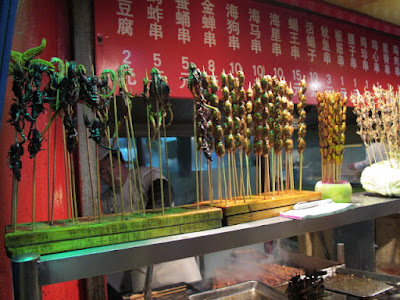
Wangfujing is one of Beijing's most famous shopping streets. The Donghuamen night market there has a huge, varied collection of street food on street known as "Snack Street." This is the place that visitors to China get some of their most cherished photos, as there are more bugs on sticks than you can shake a, well, stick at.
I consider myself a fairly adventurous eater, but I have no desire to eat bugs--especially the sort of bugs on display here. Eating bugs is basically slumming it, the practice harkens back to famine times and is based more on desperation for nutrition rather than a celebration of great taste. I'm pretty sure that the Chinese feel the same way, because Donghuamen Street was the only place I've seen bugs for dinner so far. They are likely for the benefit of tourists, although they are mostly Chinese tourists.
The skewers above had a sign that said "Sheep Penis" but the minute I aimed my camera at it the man working the booth snatched the sign away in a fluid, practiced move. I'm not sure why he wouldn't want a picture taken of the sign--perhaps it's not really sheep penis and he doesn't want to get caught? Any experts out there, please weigh in. Does that look like a sheep penis to you?
A few years ago the Chinese began to make noises that they had been the ones to invent pizza. The proof was in the street food--Chinese pizza was popping up all over Beijing and Shanghai in small stores and right out on the street. Oddly, though, they didn't mention inventing the stuff until the mid-aughties, long after Pizza Hut already had a toehold in China. No matter. It was called 'Tujia Minority Chinese-style Pizza' and they were sized like the personal pan pizza you can get in America.
Tons of Chinese pizza shops and vendors set up a couple of years ago, and seemingly shut down soon after. Tujia Minority fad food, I guess.
So when I ran across these women slanging what appeared to be fried bread in the Zhichunlu are of Beijing, I had no idea what their game was, but I knew that I wanted in on it.
Painting the bread with a spread that was as mysterious as it was delicious.
It didn't look like the traditional Chinese pizza due to the size--she'd make a giant one and chop it up and serve 4-6 people with each one. The spread was a mystery to me. It didn't taste "Chinese" to me, it had a definite Italian buzz about it. I think it was made with tomatoes and/or eggplant but I'm really not sure. After she took it off grill she topped it with sesame seeds and chopped scallions.
The dough-lady thought it was hilarious that I was taking pictures. Whenever I would walk by for the rest of the week I was there, she'd wave at me.
Liberal oil is what makes it so yummy.
Putting the dough in for another batch. Note the armwarmers.
I liked this stuff so much that I ate it three days in a row. This is also because I find every visit to a (cheap) restaurant in China excruciating. My attempts to communicate in broken Chinese is met with giggles and I usually end up playing charades and acting out what I want for lunch. Street food is easy because they usually only make one or two things and you can just point and say "zhège."
For some reason, probably due to my unusual size and coloring, the woman refused to believe that I wanted just one serving, and every day gave me two. Usually I just pay with a tenner to avoid trying to communicate about how much it costs, and a tenner will always cover street food.
They serve it to you with a skewer to eat it with.
So the first day she gave me 2 bags of pizza and ¥4 back. From this, I deduced that the bags cost ¥3 each ($0.45). The next day I handed her a fiver and made a hand gesture that I thought indicated "small." Apparently it came off as "I want two servings, but in one bag for a fiver." At this point, I realized it was a lost cause. The next day I handed over a fiver and waited for my giant bag of pizza. Instead, she demanded that I give her ¥1 more, and gave me two bags of pizza. The only explanation I can give for the varying sizes and prices is that nothing in China makes any sense, and trying to understand anything is an exercise in futility. It was delicious, regardless.
Intrepid girl reporter Laura has sent in a menu containing a Korean BBQ and kimchi poor boy sandwich spotted in New Orleans recently. She writes:
"So the restaurant was called Stanley in New Orleans (they have an upscale sister restaurant, Stella...get it?). Really good breakfast, bananas foster french toast, pancakes, lots of poached eggs, fried oysters and really really good gumbo (I had the omelet sandwich, and it was amazing)."
If anyone out there has tried this amazing creation, please send a full report and pictures.
So the Chinese are really into the whole yin and yang business. According to the philosophy, "yin and yang are complementary opposites within a greater whole." This applies to food as well--yang foods are believed to increase the body's heat and yin foods are thought to decrease it. In order to keep the body in balance, Chinese people believe that you must eat both yin and yang foods. Cantonese people claim that many conditions can be cured through food therapy--for example if you have dry skin, chapped lips and nose bleeds, you may have been eating too many yang foods (such as deep fried foods and chili pepper) and need to balance yourself out with a few yin treats (a lot of melon-y and water-y fruits and veg).
Some yang foods: beef, coffee, chocolate, garlic, peanuts, whiskey, wine, ham, cheese, butter
Some yin foods: apples, bananas, broccoli, cucumbers, grapes, honey, oranges, pineapple, strawberries
What does this have to do with these godawful potato chips, you ask? Well apparently some dude at Lay's was checking out a list of yin and yang foods and realized that they already had yang on lockdown, because basically anything fried or unhealthy ends up on that list. But they hadn't even begun to tap the yin market, which Chinese people believe they should be filling their faces with half the time.
Solution? Make some yin potato chips. Lay's 'Natural and Cool' line brings us flavors like blueberry, lime, cherry tomato, cucumber and (gag) kiwi. This allows consumers to believe they are getting their Chinese medicine recommended daily dose of yin foods, while still stuffing themselves with suspiciously yang-like calories.
The ad above shows a bunch of Chinese nature-lovers so desperate for yin foods that they are eating flower bouquets in addition to standard fruits and vegetables. Luckily for them Stephanie Sun shows up and blatantly suggests that they can dump the veg and just eat potato chips instead! Sort of reminiscent of that heady time in the 80's that Ronald Reagan and the USDA tried to classify ketchup as a vegetable in American school lunches.
The marketing company that masterminded this brilliant spot had this to say about it:
"The creative uses eating real natural foods to demonstrate that natural and cool chips are inspired by natural flavours: lime, cherry tomato and cucumber. The wacky execution was used to grab the attention of our target and instill the message that natural and cool chips are nature-lovers' favourite chips," Jennifer Chern, senior account director for BBDO Shanghai said.
So how do the chips taste, you ask? When you open the can you get a serious bang of blueberry--it smells like a cross between baking blueberry muffins and the blueberry Lipsmackers I had when I was 12. When you bite into one it tastes like artificial blueberry and sort of sweet, but then it recedes into an entirely savory, salty taste. Like most snack foods I have had in China thus far, I spent an inordinate amount of time trying to determine if what I was eating was disgusting or not, and then finally deciding they are halfway through the package. Not to say I won't finish them, but I doubt that it's going to be balancing my yin and yang anytime soon.
In China they have Pocky just like they do in Japan, but more. This is true of a lot of things in China. There are more people, there are more cars, there are more feral dogs in the street but most importantly, there are more flavors of Pocky. Way more.
Coffee, strawberry, blueberry, strawberries and cream, banana, milk, chocolate, green tea, caramel (?) almond, chocolate on chocolate, and then there are the mousse varieties, which have double the flavor coating (too much in fact): mango, almond, milk, chocolate and several variations therein.
I took home four flavors (the ones pictured above plus chocolate) and spent the next 2 days making myself sick on them. I am hoping if I just eat enough of these I will tire of them and move onto something less blatantly unhealthy like cigarettes or hot dog eating contests.